
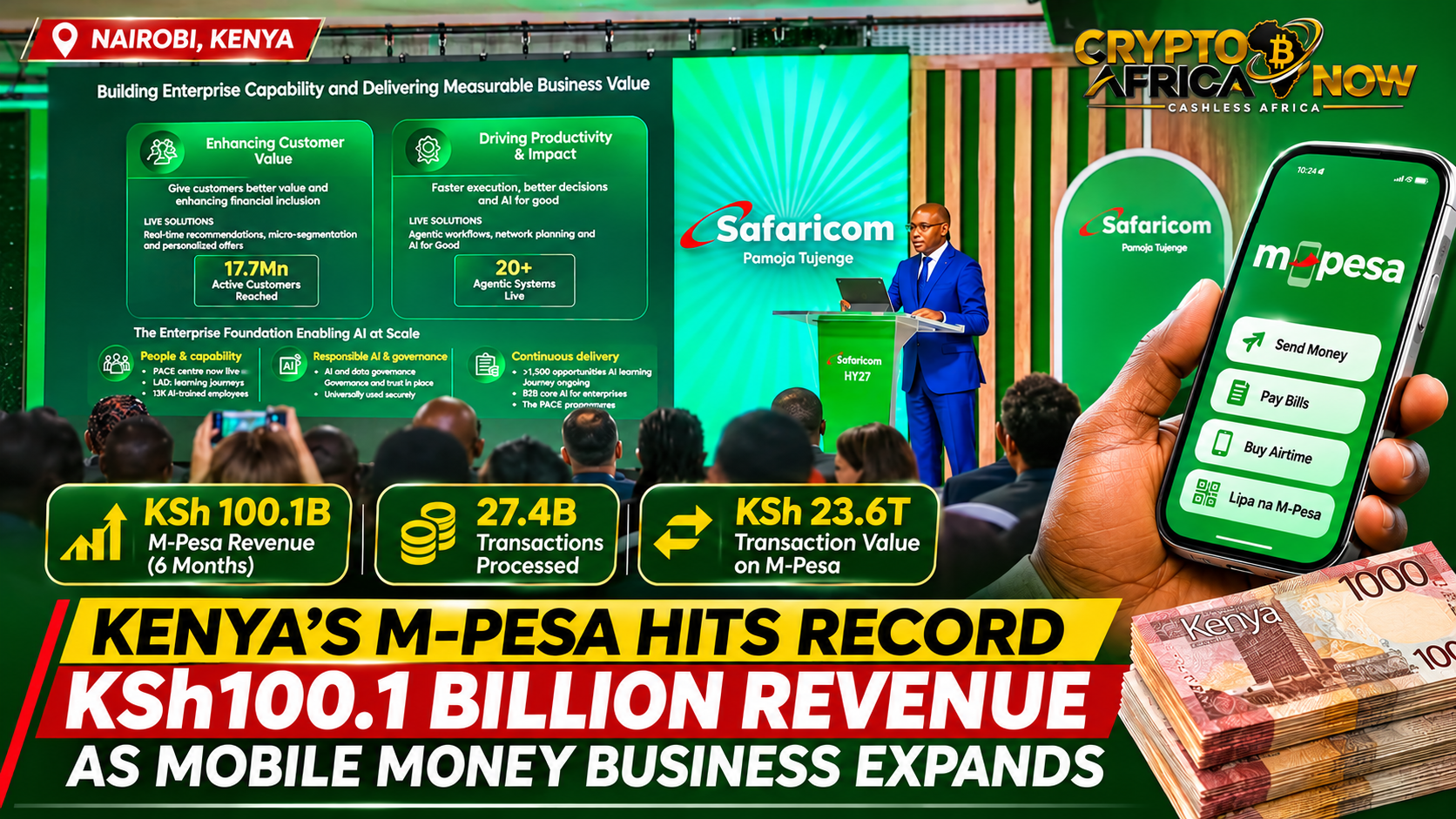
NAIROBI, KENYA — Kenya’s leading mobile money platform, M-Pesa, has generated a record KSh100.1 billion in revenue during the six months ending September 30, 2026, marking a major milestone in the country’s rapidly expanding digital payments industry.
The results, announced by telecommunications giant Safaricom on November 5, show that M-Pesa’s group revenue increased by 13.6% compared with the same period last year.
For the first time, the platform crossed the KSh100 billion revenue mark within a six-month reporting period, highlighting its growing contribution to Safaricom’s financial performance.
M-Pesa Processes KSh23.6 Trillion in Transactions
According to Safaricom’s financial results and subsequent industry reporting, M-Pesa processed approximately 27.4 billion transactions worth KSh23.6 trillion during the reporting period.
The figures demonstrate the scale of mobile money usage among individuals, businesses and merchants relying on digital payments for everyday financial activities.
However, the KSh23.6 trillion represents the total value of transactions processed through the platform, not revenue earned by Safaricom.
The company also reported group net income of KSh58.2 billion, representing a 35.9% increase, while group service revenue reached KSh226.1 billion.
More Than Half of M-Pesa Transactions Were Free
Safaricom revealed that approximately 53% of M-Pesa transactions during the six-month period were free or zero-rated.
According to the company, around 81% of merchant transactions through Lipa na M-Pesa and Pochi la Biashara attracted no charges.
Similarly, approximately 63% of consumer transactions were processed without fees.
The figures reflect Safaricom’s efforts to encourage wider adoption of mobile money services while keeping many routine transactions accessible.
However, charges still apply to certain transfers, withdrawals and other financial services.
Mobile Money Expands Beyond Cash Transfers
M-Pesa has evolved from a basic money transfer platform into a wider digital financial services ecosystem.
Today, customers use the platform to pay bills, purchase goods, transfer money, access savings products and obtain short-term credit.
For small businesses, mobile payments provide an alternative to cash transactions while helping merchants maintain digital records of their daily sales.
The growing use of mobile money also reflects changing consumer behaviour as more Kenyans embrace cashless financial services.
Safaricom Records Strong Growth in Ethiopia
Beyond Kenya, Safaricom reported significant growth in its Ethiopian operations during the same period.
The company recorded KSh10.6 billion in Ethiopia service revenue, representing a 71.6% increase.
Safaricom Ethiopia also reported approximately 15.4 million customers active within the preceding three months.
Meanwhile, its earnings before interest, taxes, depreciation and amortisation (EBITDA) loss narrowed to KSh434.4 million.
The figures reflect the wider Ethiopian telecommunications business and should not be confused with standalone M-Pesa Ethiopia revenue.
M-Pesa Strengthens Africa’s Digital Economy
M-Pesa’s latest performance highlights the increasing importance of mobile money in Africa’s financial technology sector.
As more consumers and businesses move towards digital transactions, mobile payment platforms are becoming essential to commerce, financial inclusion and economic activity.
However, continued growth also brings challenges involving cybersecurity, transaction fees, service reliability and competition.
For regulators and industry participants, ensuring that mobile payment networks remain secure, affordable and accessible will be critical.
Safaricom’s latest results demonstrate the commercial strength of mobile money, but the long-term measure of success will be how effectively these services improve everyday financial transactions for consumers and businesses.
Have Your Say
Has M-Pesa made sending money and running your business easier, or do transaction fees, fraud and network interruptions remain major challenges?
Share your opinions and questions in the comments. We welcome your contributions to discussions about Africa’s digital financial future.
For cryptocurrency, Web3, blockchain, AI and fintech events, media coverage, partnerships and enquiries, contact: sales@cryptoafricanow.com
Crypto Africa Now | Cashless Africa

Ndasi Tata is a Bitcoin entrepreneur from Cameroon, who holds an M.Sc in Blockchain and Digital Currency from the University of Nicosia. He is an advocate of Bitcoin in Africa and uses various social media platforms to promote his ideas and ventures. Tata has a background in state journalism and has established himself as a significant figure in the Bitcoin community.